UMO® Studio · Guides
Why use a carbon filter in your pipe or holder?
A carbon filter sits between the tobacco and your lips. Here is what the charcoal inside actually does to the smoke — and where its limits are.
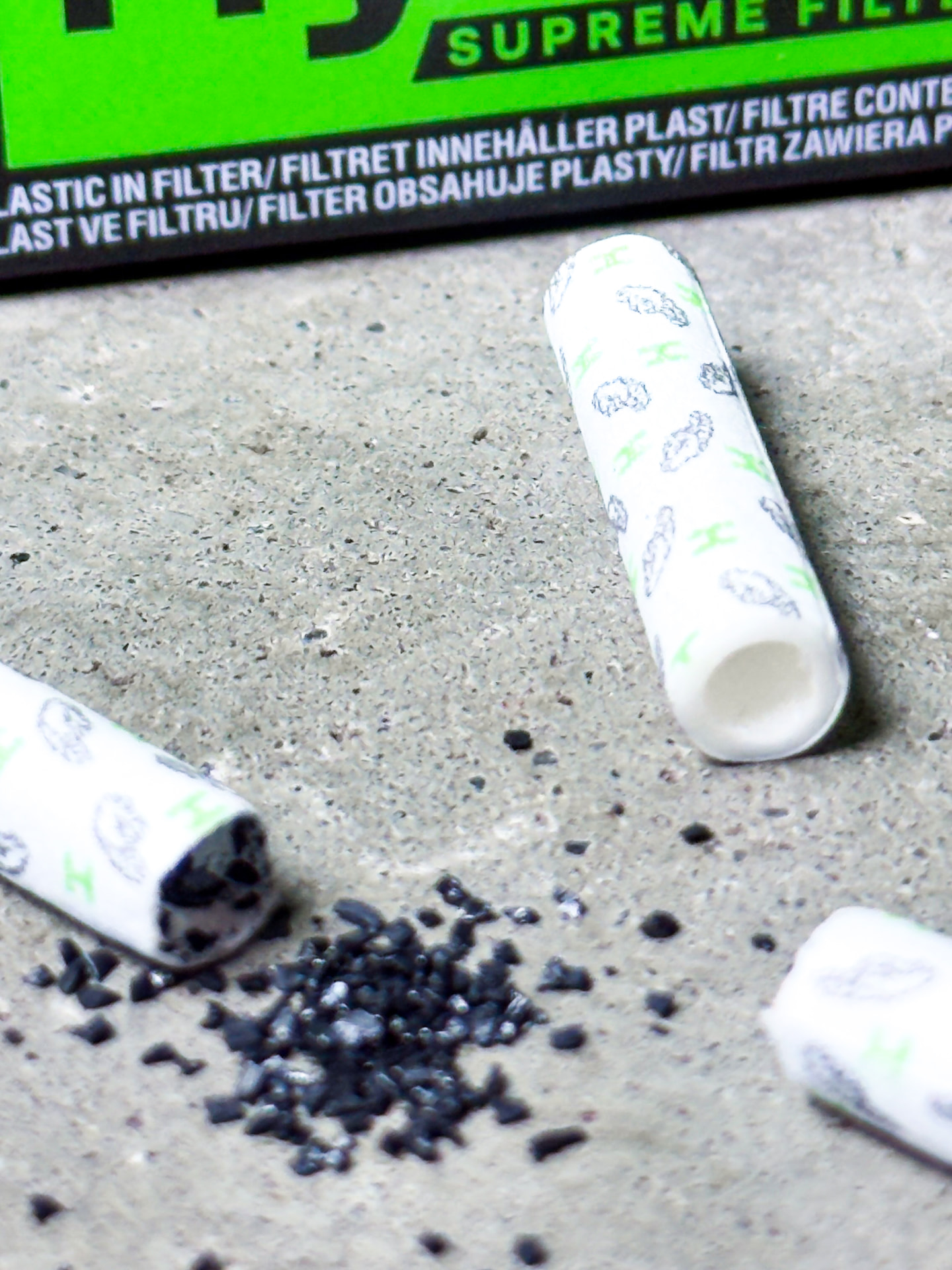
What activated charcoal does
Activated charcoal is carbon riddled with microscopic pores — a single gram unfolds a surface larger than a football pitch. As smoke is drawn through the filter, gas molecules settle on that surface. This is called adsorption, and it works on vapours rather than droplets: many of the compounds in smoke travel as gas, and those are exactly the ones the charcoal can catch.
What it catches — and what it does not
Charcoal adsorbs volatile compounds best: aldehydes such as formaldehyde, acetaldehyde and acrolein, solvents like benzene and toluene, plus ammonia and hydrogen cyanide. Cannabinoids and terpenes, the compounds that carry aroma and character, are left largely untouched as well. In laboratory tests, densely loaded charcoal filters reduced these carbonyls by close to 99 percent — while tar and nicotine barely moved, because they ride on smoke particles, which the carbon mostly lets pass. The mechanical part of your filter catches those particles; the charcoal handles the gases. And no filter makes smoking safe.
Why the smoke feels different
Many of the compounds charcoal catches are the sharp, irritating ones. Smoke drawn through a carbon filter carries measurably fewer vapour-phase irritants and gas-phase free radicals — around 40 percent fewer in one study — which is why it tastes rounder, scratches less at the throat and leaves less smell on fingers and in the room.
A filter that wears out
Adsorption has a limit: once the pores are full, smoke passes through unchanged. That happens sooner with hard, fast puffs than with slow draws, so a carbon filter is a consumable, not a fixture. Replace it regularly — in daily use we change ours after a few sessions — and store spares dry and sealed, so humidity does not fill the pores before the smoke does.
Matching filter to holder
All our cigarette holders take optional filters of 6 to 6.3 mm in their inner chamber, while the intake for the cigarette itself accepts any filter or tip from 4 to 8.2 mm. Stainless-steel filters can move from one piece to another, and a holder with a slightly wider bore keeps the draw effortless even with a fresh filter in place.